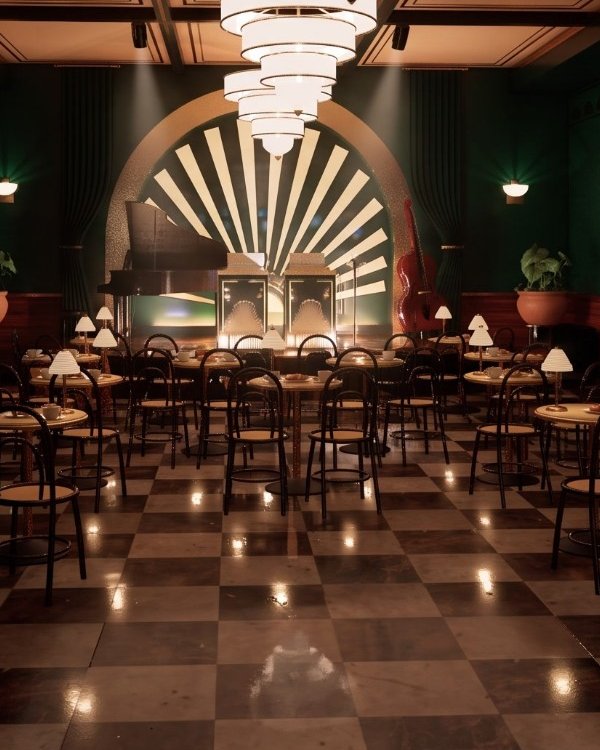
Early evening
Jazz stage
Seated live jazz in the early evening, honouring the Black American musicians who created the music, from Bessie Smith to Louis Armstrong's Hot Five.
(working name)
Seoul's Jazz Age, by day and after dark.
Concept render, not a photograph of a real room
A 1920s Jazz Age room coming to Seoul, with seated live jazz in the early evening and a cafe counter by day. It is the place to come back to at the end of the day and slow down, and to be recognised when you do, whether you are visiting Korea or live around the corner.
Early evening
Seated live jazz in the early evening, honouring the Black American musicians who created the music, from Bessie Smith to Louis Armstrong's Hot Five.
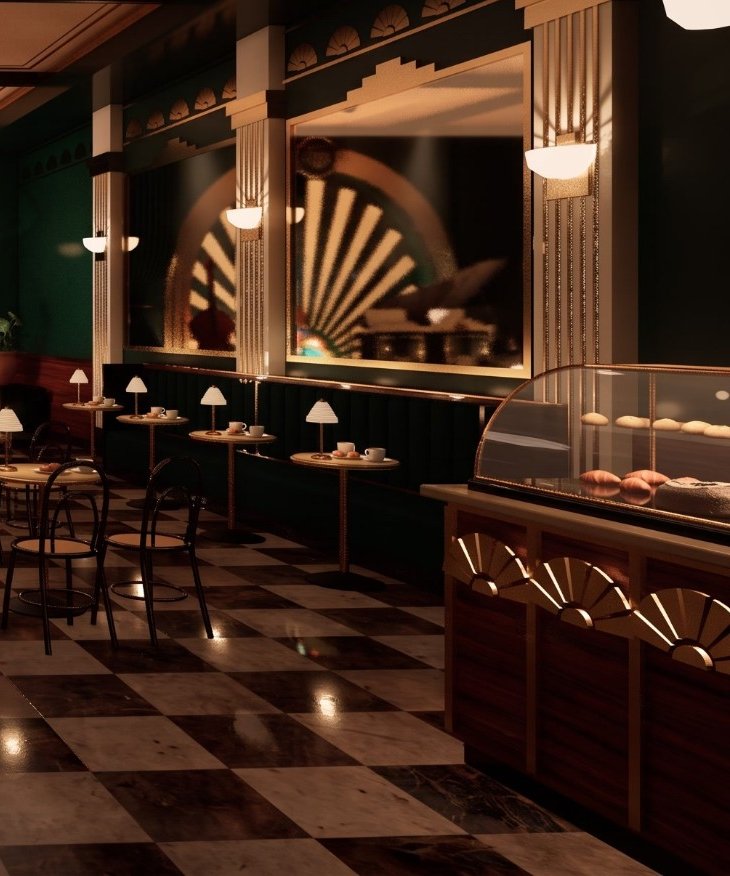
By day
Coffee, egg creams and zero-proof sodas. During American Prohibition (1920 to 1933) soda fountains became a popular alcohol-free place to meet; by 1925 there were more than 91,000 of them.
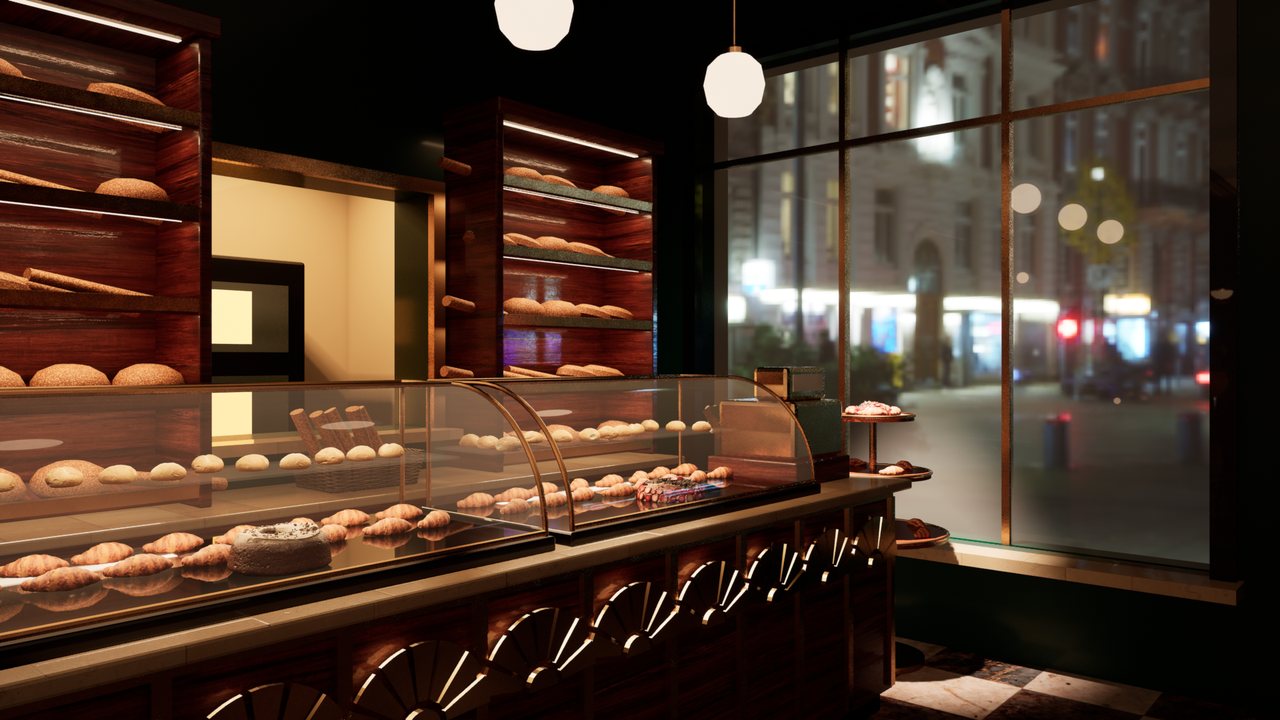
By day
Breads and cakes from the machine age: the 1928 sliced loaf, the 1925 pineapple upside-down cake, the icebox cake. Modern favourites are labelled as modern.
Walkthrough
In from the street past the bakery counter and the coffee bar, then down the room to the bandstand as the early evening set begins. This is a concept visualization, not a final design: the location, layout and name are still being decided.
Music: "St. Louis Blues" by W. C. Handy (1914), sung by Bessie Smith with Louis Armstrong on cornet, recorded in 1925; the recording is in the public domain in the United States. Rendered in Unreal Engine with MetaHuman characters; some furniture, food and textures are CC0 assets from Poly Haven.
The story
Duke Ellington began his run at Harlem's Cotton Club, a segregated club that booked Black performers for white-only audiences.
Under Japanese colonial rule, film director Lee Kyung-son opened Kakadu, described as the first dabang (coffee house) run by a Korean. Six years later the poet Yi Sang opened a dabang where writers gathered.
We want to tell both stories honestly, including the segregation and colonial rule that shaped them.
Regulars
Most places only remember you when the same person is on shift. We want the memory to travel with you instead.
If you like, we give you a paper card and write your usual on it, in your words. No name needed, no app, no sign-up. The card is yours.
Show the card and we read your order back before you say it, with a small taste of whatever has just come out of the oven.
Choose a cup from the shelf and a mark for it. It is kept for you and used whenever you visit.
The card has no expiry. Come back in three years and we will still read your order back first.
A concept in planning; details may change.
Correspondence
Tell us you are interested and we will email you opening news and invitations to pop-up jazz and bakery events.
Sign-ups are not open yet. This form does not send or store anything.